
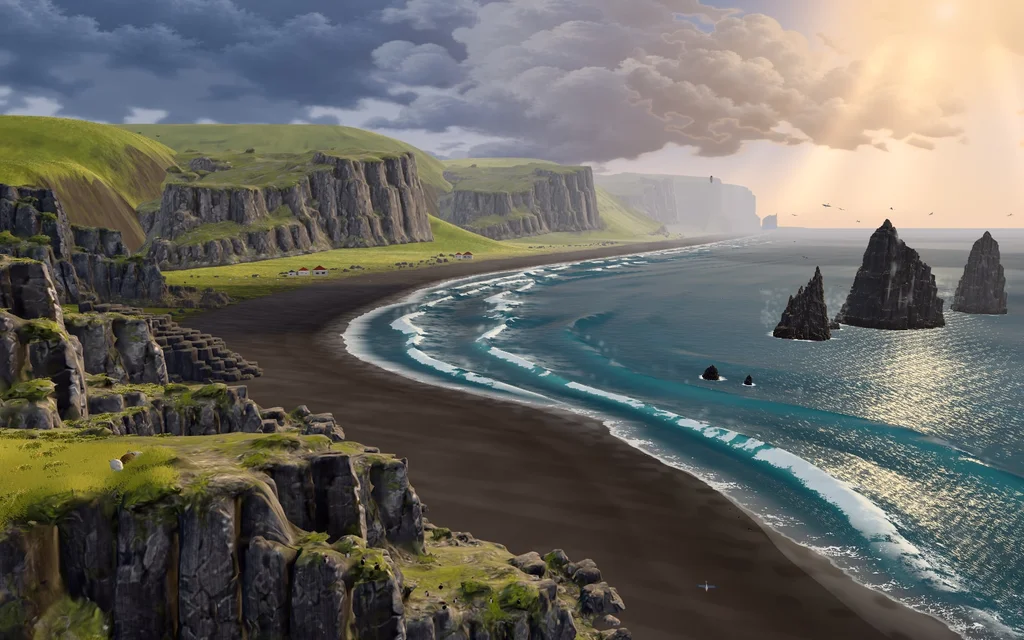
Iceland · ReynisfjaraBlack Sand Tides
Legend says two trolls hauling a ship ashore were caught by dawn and turned into the stacks offshore.
What you’ll hear
- Surf
- Sea breeze
- Seabirds
In the 3D scene you can change the time, season and weather, or follow the local time.
About this place
Reynisfjara lies on Iceland’s south coast just west of the village of Vík, under the 340 m Reynisfjall. Its sand is volcanic rock and ash ground down by the sea; basalt columns stand at the foot of the cliff, and the Reynisdrangar stacks offshore reach 66 m. The surf is unpredictable, with waves that surge far up the beach even on calm days, so the local rule is never to turn your back on the sea. Midsummer days last about 20½ hours and the night never fully darkens; at midwinter there are only about 4½.
Fulmars nest all over the cliffs and stacks. Puffins return in late April and May to raise their chicks on the grassy slopes and leave by mid-August. Arctic terns hover over the surf, oystercatchers follow the retreating waterline, and sheep roam the hillsides from late spring until the September round-up. From late June to early July the slopes below the cliffs are covered in lupins. On the Dyrhólaey headland to the west stands a lighthouse built in 1927, flashing white every 10 seconds.
Through the year
Daylight is calculated from the latitude; the puffin row is a rough guide from published sources.
Month by month
- JanuaryFive or six hours of daylight; occasional snow
- FebruaryLonger days; aurora on dark clear nights
- MarchEquinox: day and night are equal
- AprilThe first puffins return late in the month
- MayFrom late month the night never fully darkens
- JuneAbout 20½ hours of daylight at the solstice
- JulyLupins peak early; puffins are feeding chicks
- AugustPuffins leave mid-month; dark nights return
- SeptemberSheep are rounded up; aurora season begins
- OctoberThe slopes turn tawny
- NovemberDaylight shrinks to six or seven hours
- DecemberAbout 4½ hours of daylight at the solstice
Four seasons
Late May · Spring
Puffins are back on the cliffs, the slopes are greening, and at 1 am the sky is still blue-grey.
Late August · Summer
The clifftop grass is at its greenest and a low evening sun warms the stacks and the surf.
Mid-October · Autumn
The slopes turn tawny, the days shorten, and clear nights may bring the aurora.
January · Winter
Five or six hours of daylight, snow on the cliffs, and only the waves moving on the black sand.
Best moments
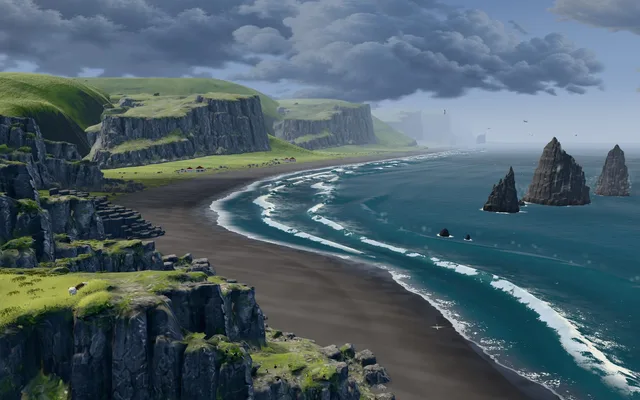
Black sand in summer
Aug 20 · 13:20 · Clear
An August afternoon: white surf rolls up the black sand under cliffs at their greenest.
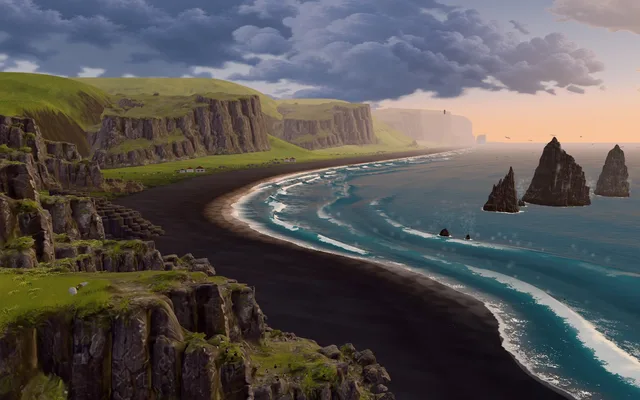
Late summer glow
Aug 20 · 20:45 · Clear
Past eight the sun still hangs over the sea, warming the sea stacks and the surf.
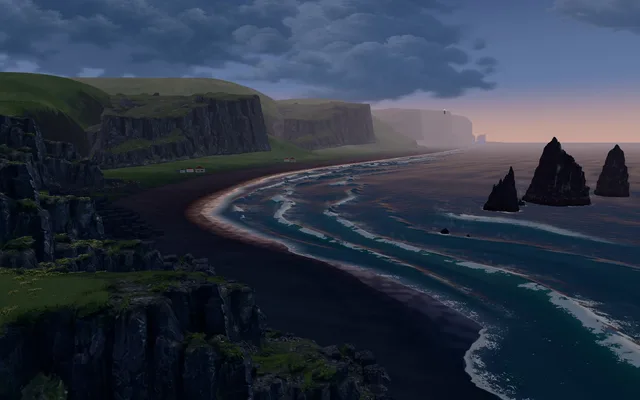
A May white night
May 20 · 01:10 · Clear
One in the morning in May: the sky never goes fully dark and sea and sand are blue-grey.
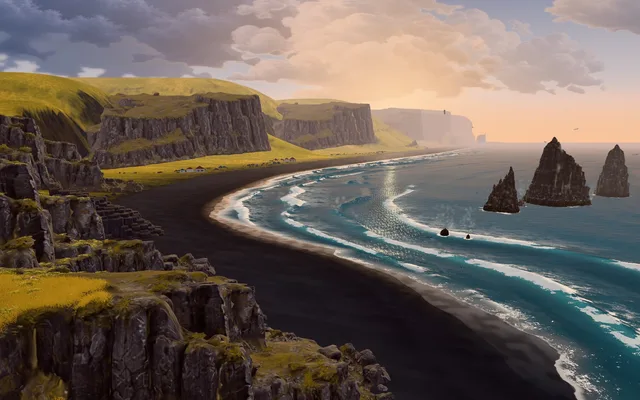
Autumn low sun
Oct 15 · 17:35 · Clear
An October evening with low sun breaking through cloud and the clifftop grass gone gold.
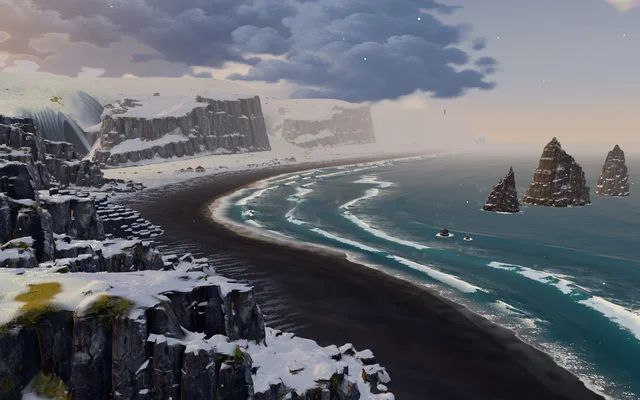
Snow on black sand
Jan 18 · 13:25 · Snow
January snow covers the cliffs; on the black beach only the waves keep moving.
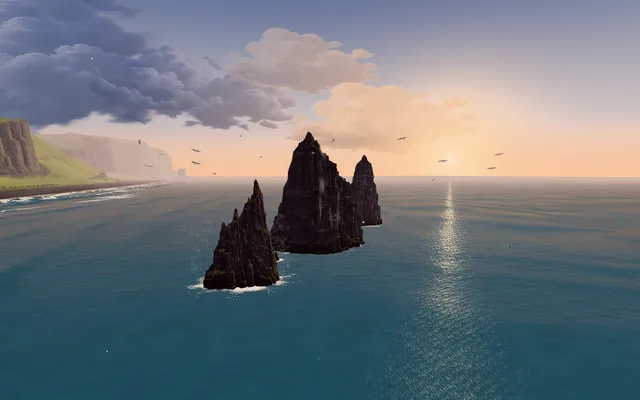
Sea stacks at sunset
Aug 20 · 20:45 · Clear · Sea islands
Facing the open sea as the sun drops behind the stacks and lays a band of light on the water.
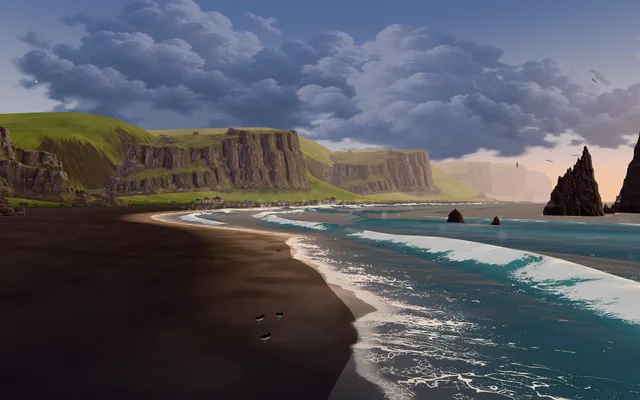
At the waterline
Aug 20 · 20:45 · Clear · Shoreline
Down at the waterline, each retreating wave leaves a shining film on the black sand.
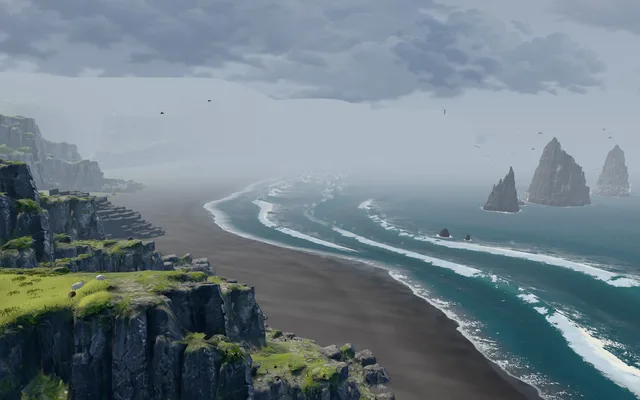
Sea fog
Aug 20 · 13:20 · Fog
Fog rolls in off the sea, the stacks fade to outlines and the surf sounds closer.
The coast, stacks and lighthouse are rearranged for the composition, so bearings and positions are not surveyed, and the seabirds and lighthouse are drawn larger than life. The heavy surf was recorded at Reynisfjara itself; a few calls, including the puffins, are the same species recorded elsewhere.
In the 3D scene you can change the time, season and weather, or follow the local time.
Enter sceneMore to explore
See all places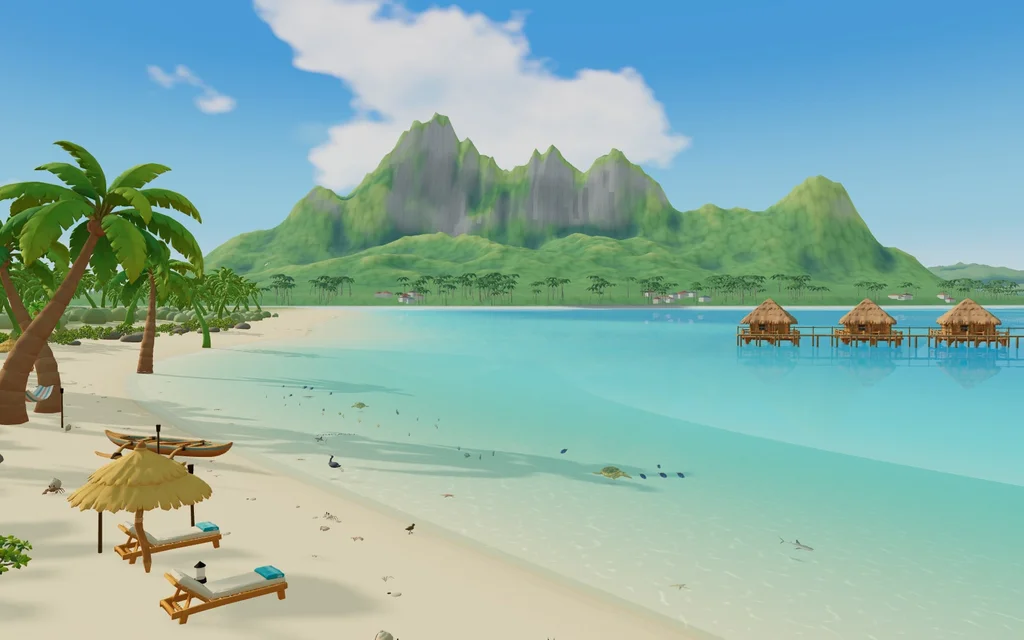
Palm Lagoon
French Polynesia · Bora Bora
Palm shadows drift across clear water and gentle tides.
2 mGentle surfPalm breezeSeabirds
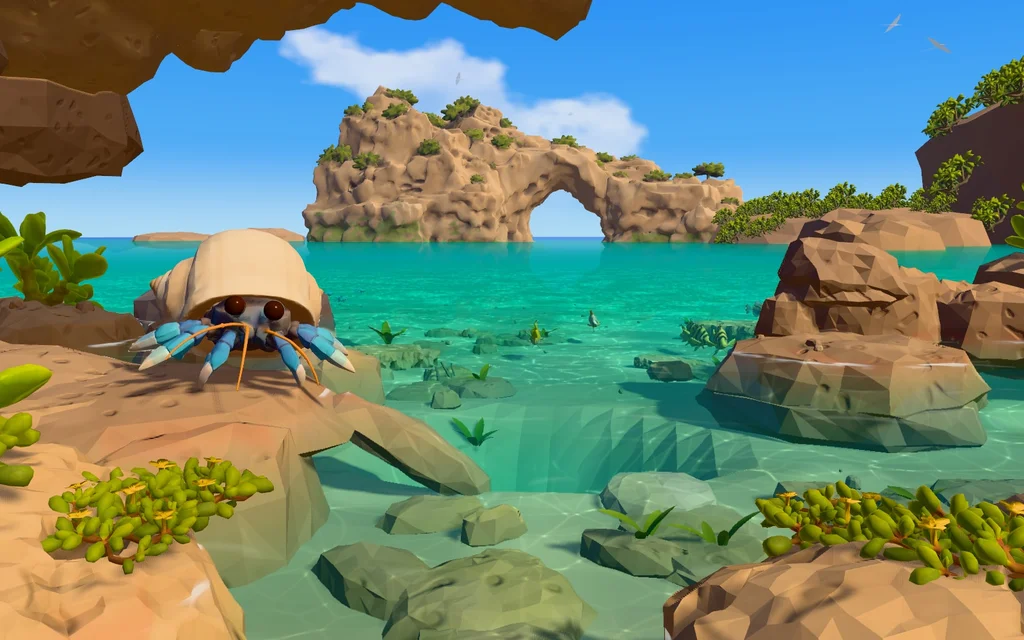
Blue Tide Pools
Niue · Limu Pools
Beyond the limestone arch, a sheltered pool of blue.
1 mTidal waterSea breezeSeabirds
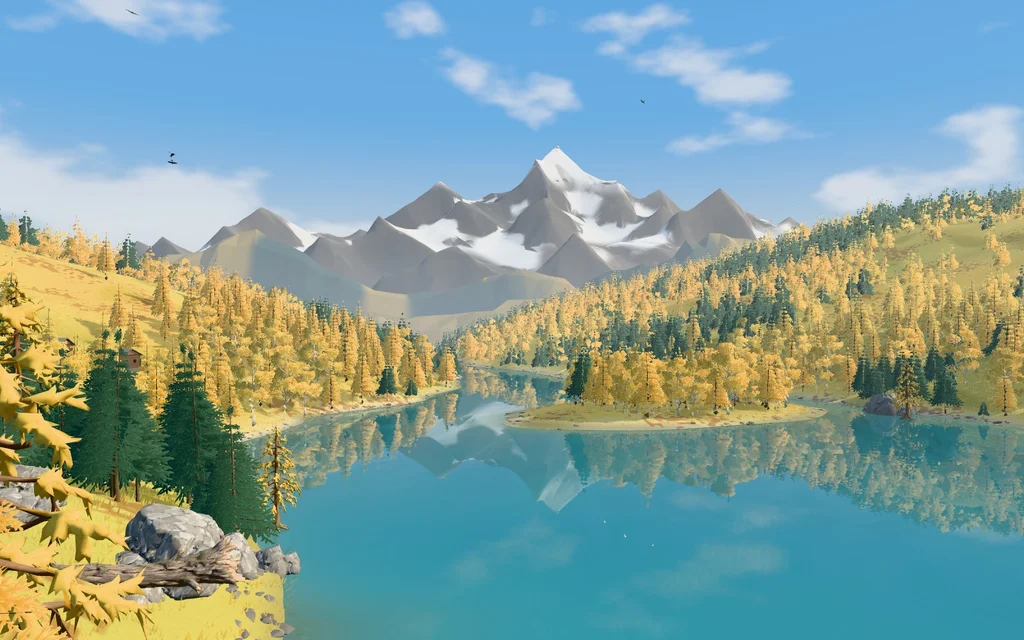
Golden Valley
China · Xinjiang · Kanas
Autumn trees reflected in the lake, a breeze from the mountains.
1,374 mLakeForest breezeBirdsong